Who is paying for the conversation?
A university should teach a young person how to think, including how to challenge the people paying the bills. Parents should not have to wonder whether the institution entrusted with their child’s education has become too financially comfortable with a foreign power to ask difficult questions. When the money comes from Qatar, those questions deserve answers in public, without treating the person asking them as the problem.
The scale is substantial. In its February 2026 release of university disclosures for 2025, the U.S. Department of Education identified Qatar as the largest country of attribution, with more than $1.1 billion in reportable gifts and contracts. That includes government and nongovernment sources. It is a financial relationship worth examining, rather than a marginal donation that can be waved away as irrelevant.
Does that establish a Qatari operation to turn students against Christianity or convert the West to Islam? No. The records examined here do not establish that sweeping claim. They do establish a serious reason to investigate donor influence, contractual conditions and institutional dependence. Conservatives should insist on that investigation. Our argument becomes stronger when we distinguish the evidence from the conclusions we would need more evidence to reach.

Qatar leads the 2025 disclosures
Does the ‘99% Democrat’ chart tell the whole story?
No. The circulating chart supplied for this article labels Harvard’s faculty as 99% Democratic, but its own subtitle excludes independents, unregistered people and other parties. That changes the denominator. A percentage calculated only among Democrats and Republicans cannot be presented as the political identity of every professor. The image also supplies no visible date, underlying dataset or method, so its individual university figures cannot be independently verified from the attachment.
There is better evidence for asking about political imbalance. The Harvard Crimson’s 2025 survey of the Faculty of Arts and Sciences reported that roughly 63% of respondents identified as liberal and 9% as conservative. It received 406 complete or partial responses after contacting more than 1,400 faculty members. Those are responses from one faculty division, subject to nonresponse and self-selection—not a census of Harvard or American higher education.
The conservative concern remains legitimate: can students confidently challenge the prevailing politics without fearing ridicule or damage to their academic prospects? Universities should demonstrate that they can. But a left-leaning survey result does not tell us why a professor holds a view, whether a donor influenced it, or whether a class is propaganda. Political imbalance and foreign financing are separate questions until evidence connects them.

A liberal majority in Harvard’s faculty survey
Why would Qatar spend so much on American universities?
Qatar’s stated explanation is education and national development. Qatar Foundation describes its mission in terms of education, research and community development, with international universities operating in Education City. Georgetown announced in April 2025 that it had renewed its Qatar partnership for another ten years, through 2035. Medical training, research and degree programmes are real activities; an honest investigation cannot pretend that every dollar purchases political activism.
The accounting also matters. A March 2026 Congressional Research Service report put Qatar-attributed transactions at about $8.8 billion as of 23 February 2026. That is an aggregate of reported gifts and contracts, not a single year’s donations to U.S. classrooms. The report’s largest contract example—about $1.1 billion for Cornell’s Qatar medical operation—covered January 2026 to June 2032. Multi-year commitments should not be described as money already spent in one year.
What else could Qatar gain? Prestige, relationships with future decision-makers, access to expertise and a reputation as an indispensable international partner are plausible benefits. That is an analysis of incentives, not proof of a secret instruction manual. A small, wealthy state can pursue influence while also providing genuine educational opportunities. The question for universities is whether the benefits they receive make them less willing to challenge the partner providing them.

The cumulative funding relationship
Can a donor shape the agenda without ordering a professor what to say?
Yes, it is possible. Funding helps decide which centres exist, which topics receive sustained attention and which partnerships become institutionally important. That does not automatically make the resulting research dishonest. It does mean that a promise of independence should be tested against the contract and the institution’s behaviour. Who selects the subjects? Who is consulted about appointments? Can the university walk away without becoming financially vulnerable?
A June 2026 report by Hussein Aboubakr Mansour for the Jewish Institute for National Security of America analysed released Georgetown and Northwestern agreements. It highlighted consultation provisions, intellectual-property arrangements and access through advisory bodies. It also described a $630,000, three-year Qatari foreign-ministry grant for Georgetown’s Bridge Initiative research on Islamophobia. Those are specific arrangements that merit scrutiny; the report’s broader claim of institutional capture is the author’s interpretation, not a judicial finding.
There is a crucial qualification. The grant agreement reproduced in that report expressly protects academic freedom and bars the ministry from directing the initiative’s research, scholarship or teaching. Research into anti-Muslim prejudice is not inherently propaganda. The concern is whether a foreign government can influence priorities and conference discussions despite that protection. Publish the agreements and assess the outputs: do scholars scrutinise their funder as freely as they scrutinise Western governments?

What do the documented Hamas connections actually prove?
They justify serious scrutiny of named people and transactions. On 18 October 2023, the U.S. Treasury sanctioned Hamas financial facilitators, including Muhammad Ahmad ‘Abd Al-Dayim Nasrallah, whom it identified as a longstanding Hamas operative based in Qatar. Treasury said he had helped transfer tens of millions of dollars to Hamas, including its military wing. That is a concrete official action with a named subject, rather than a vague allegation against an entire population.
The diplomatic history is complicated too. A February 2024 Congressional Research Service report documented Qatar’s hosting of Hamas political figures and its role in hostage diplomacy. It also described Qatar as a major U.S. defence partner, hosting Al Udeid Air Base and holding major non-NATO ally status. Those relationships help explain why Washington has worked with Doha despite profound concerns. Strategic usefulness does not settle questions about conduct, and diplomatic contact is not itself proof of terrorist financing.
Do those facts prove that a particular university grant funds terrorism or a student protest takes instructions from Hamas? They do not. That connection requires its own evidence. Universities should disclose their counterparties and authorities should investigate sanctions violations and unlawful financing. Neither an accusation of prejudice nor a broad accusation of complicity should substitute for tracing the actual money. Accountability depends on getting the people, payments and evidence right.

Why should defending Western values require an apology?
It should not. A conservative case for education starts with gratitude as well as criticism: gratitude for freedom of conscience, accountable government, scientific inquiry and traditions that allow authority to be questioned. Christianity belongs in that conversation as a living faith and a major part of Western inheritance. Teaching historical wrongs need not mean teaching students that their country, religion or civilisation has nothing worth defending. Honest education can confront failures without demanding permanent self-contempt.
The test becomes urgent when political passion turns into intimidation. In March 2026, a Republican-majority staff report from the House Education and Workforce Committee criticised university leadership and faculty conduct over campus antisemitism. Its conclusions should be assessed as a congressional majority’s findings, rather than a neutral verdict on every campus. But the principle is straightforward: Jewish students deserve safety and equal treatment. So do Muslim and Christian students. Lawful advocacy for Palestinians must not be confused with harassment or support for attacks on civilians.
Here is a question progressive institutions should welcome: are you as willing to investigate restrictions on liberty in a wealthy partner state as you are to condemn injustice at home? And here is the conservative obligation: oppose political movements that seek religious coercion without treating every Muslim as their representative. Political Islam should be examined through its programmes, organisations and actions. A person’s religion alone does not establish allegiance to those programmes. Defending freedom requires that distinction.

Does New York prove a Qatar-backed Islamist takeover?
No such conclusion follows from the evidence reviewed here. New York’s mayor, Zohran Mamdani, described himself in his January 2026 inaugural address as a democratic socialist and a Muslim. Conservatives are entitled to challenge his economic programme, spending priorities and approach to public safety. His religious identity, however, does not by itself establish that he governs as an Islamist or that Qatar financed his rise.
If someone alleges a foreign influence operation behind a politician, the next questions should be practical: which donor, which organisation, which payment, which instruction, and which documented connection? An unpopular policy is open to criticism without an unsupported foreign-control allegation attached to it. Calling a politician a socialist because he describes his politics that way is different from calling him a foreign agent because of his faith. Readers deserve arguments that survive that distinction.
The same standard protects Christians. The First Amendment’s religious guarantees would mean little if public service became conditional on abandoning faith. A confident Western society can defend churches, Christian expression and freedom to disagree while protecting the same civic rights for neighbours of other religions. It can also reject coercion, threats and attempts to place religious authority above equal civil law. These principles are stronger when applied consistently.

What should a confident West demand now?
Start with disclosure that ordinary people can understand. The March 2026 CRS explanation of Section 117 describes a $250,000 annual reporting threshold for gifts and contracts from a single foreign source at covered institutions. That is a baseline. Universities should also publish accessible agreements, identify the real funding counterparties and explain appointment, research, confidentiality and intellectual-property conditions. Apply that expectation to Qatar, China and every other foreign partner—not only governments currently disliked by one political party.
Then test independence in practice. Commission external reviews of donor conditions. Protect students and scholars who criticise a funder. Enforce rules against threats consistently, and judge scholarship by its quality rather than its usefulness to a political cause. Broaden serious intellectual debate without replacing one ideological test with another or imposing party quotas. Where credible evidence indicates unlawful financing, refer it for investigation and preserve due process. A university should be able to explain both where its money comes from and what its money cannot buy.
Parents should not need a lawyer to discover who is underwriting the institutions shaping their children’s future. Nor should a student have to choose between intellectual ambition and the freedom to value Christianity, country or Western constitutional traditions. Qatar’s university relationships deserve sustained scrutiny. Our response should be confident enough to ask uncomfortable questions, disciplined enough to follow the evidence, and determined enough to insist that academic freedom is practised when a powerful donor would prefer silence.

Sources and research notes
Research checked on 21 November 2026. Financial figures retain the dates and definitions of the cited releases; cumulative contracts are not treated as annual expenditure. The supplied faculty chart has no visible original source or methodology and is not reproduced as verified data. This article combines sourced reporting with explicitly conservative editorial judgement. Illustrative location photographs do not show the events or agreements discussed.
U.S. Department of Education — 2025 foreign-funding disclosures (11 February 2026) — Reported gifts and contracts; country attribution includes state and non-state sources.
Congressional Research Service — Section 117 of the Higher Education Act (25 March 2026) — Dated funding totals, Cornell contract period and disclosure rules. Copy of CRS report IF12927.
The Harvard Crimson — Faculty of Arts and Sciences political survey (3 September 2025) — Survey organiser’s account of methods and respondents; not a faculty census.
Qatar Foundation — About Qatar Foundation — The foundation’s own statement of its educational and development mission.
Georgetown University — Qatar partnership renewal (17 April 2025) — University announcement of the ten-year renewal through 2035.
Hussein Aboubakr Mansour / JINSA — Higher Influence (June 2026) — Contract analysis and reproduced provisions, especially printed pages 3–5. Its interpretations are attributed to the author; the grant’s academic-freedom clause is included.
U.S. Treasury — Hamas financial-facilitator sanctions (18 October 2023) — Named Qatar-based operative and Treasury’s stated reasons for sanctions.
Congressional Research Service — Qatar: Issues for the 118th Congress (15 February 2024) — Historical context on Hamas, mediation and U.S.–Qatar defence relations; not a claim that every 2024 circumstance remains unchanged.
House Education and Workforce Committee — Majority staff report announcement (17 March 2026) — Congressional majority’s account of its campus antisemitism investigation.
NYC Mayor’s Office — Zohran Mamdani’s inaugural address (1 January 2026) — His own description of his politics and religious identity.
United States Courts — First Amendment and religion — Establishment and free-exercise protections.
Chart sources
2025 funding: U.S. Department of Education, source 1 above. Faculty survey: The Harvard Crimson, source 3. Cumulative funding: CRS, source 2. These charts cover different measures and periods and do not establish a causal relationship between funding and faculty politics.
Image sources and illustration note
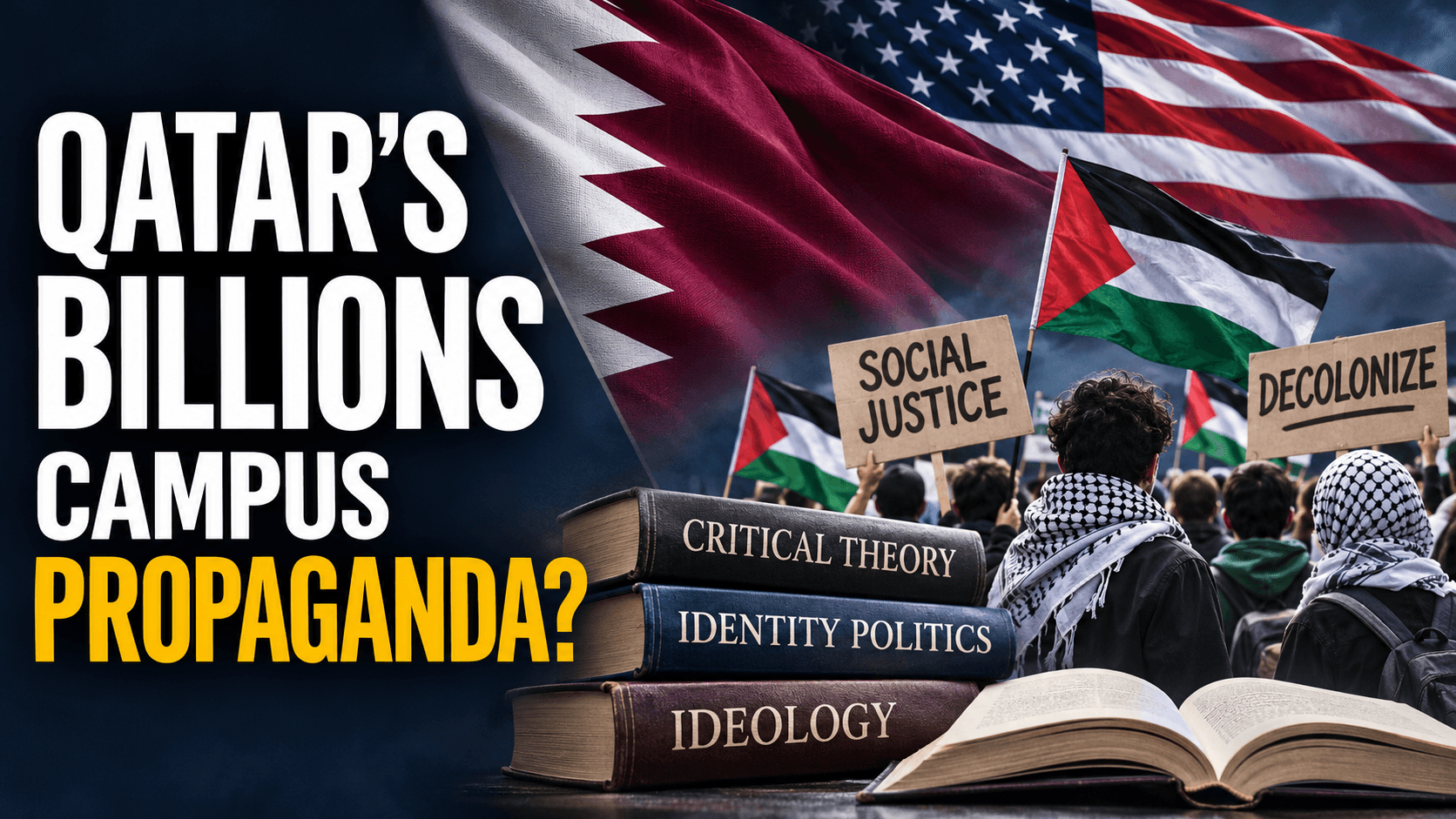
The thumbnail is an editorial illustration generated for Rodaportal, combining flags, books and a conceptual protest scene; it is not a documentary photograph of a specific event. The article’s location photographs are displayed in consistent centre-cropped 16:9 frames.
Harvard Yard, Cambridge, Massachusetts. — CC0 / Public Domain (as stated on source page)
Langdell Hall at Harvard University, Cambridge, Massachusetts. — CC0 / Public Domain (as stated on source page)
Doha, Qatar — CC0 / Public Domain (as stated on source page)
Widener Library, Harvard University — CC0 / Public Domain (as stated on source page)
The U.S — CC0 / Public Domain (as stated on source page)
Duke University Chapel, North Carolina — CC0 / Public Domain (as stated on source page)
New York City skyline — CC0 / Public Domain (as stated on source page)
The U.S — U.S. government public domain · Toni Smith / USGS